Decision train classifier
Decision train is a classification/regression model, which I first introduced as a way to speed up gradient boosting with bit-hacks, so it's main purpose was to demonstrate how bit operations coupled with proper preprocessing of data plus revisiting can speed up training/application of trained formula. It may sound strange, but this incredibly fast algorithm was written in python (all the computationally expensive things are using numpy).
In general, I found it's basic version to be no worse than GBRT from scikit-learn. And my implementation is of course much faster.
Am interesting moment of my approach: I am writing hep_ml library in modular way, for instance, considering GBRT implementation, there are separate classes/functions for:
- boosting algorithm
- base estimator (at this moment only different trees supported, but I believe that one can use any clustering algorithm, like k-means, which sounds a bit strange, but after experiments with pruning this becomes obvious, that getting estimators from some predefined pool can yield very good results in classification)
- loss function. The only difference between regression, binary classification and ranking for gradient boosting is in the loss you use.
- splitting criterion (actually, this may be called loss function too), the FOM we minimize when building a new tree, but GBRT usually uses simply MSE as such criterion)
This 'modular structure' made it possible to write loss functions once and use with different classifiers.
Maybe, I'll find a time to provide a support of FlatnessLoss inside my neural networks (since it is flexible and uses only gradient, this should be not very complicated).
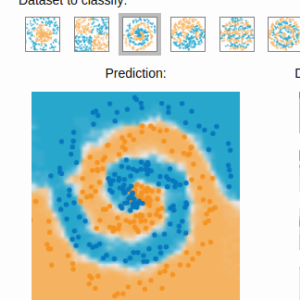 Gradient boosting
 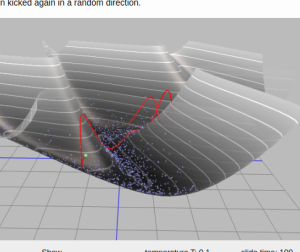 Hamiltonian MC
 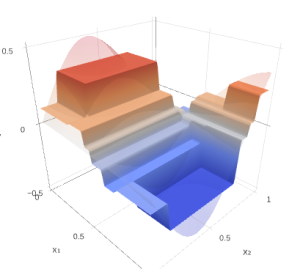 Gradient boosting
  Reconstructing pictures
  Neural Networks